How fast to fall through the Earth?
And the answer to everything
Imagine a straight frictionless tunnel between two points on Earth - step in and fall. How long will it take to get to the other side? How does it depend on where you dig? Pick your route:
- Straight through the centre and out the other side. The full diameter is 12,742 km of tunnel, bottoming out 6,371 km down at the core. You would scream through the middle at 28,000 km/h, roughly Mach 23 (23x the speed of sound).
- A short hop between cities - straight from London to Berlin, or from Washington DC to Chicago. Both are close to 900 km,d a shallow tunnel through the Earth’s crust that dips just 17 km down. Top speed a comparatively sleepy 2,000 km/h.
So which one gets you there first? What if I told you they arrive at the same exact time? Let’s investigate.
Assumptions
Like any good physicist’s planet: Earth is a perfectly uniform sphere, density is the same all the way down, and it doesn’t rotate for the purposes of this problem. Our tunnels are rigid and frictionless, and you have no problems with intense heat.
First, guessing the answer without solving anything
Dimensional analysis is a beautiful art. Before touching any equation of motion, ask what the answer could possibly be built from. The plausible ingredients that could appear in the answer for a spherical uniform planet are Newton’s constant , the planet’s density , the planet’s radius , and the specific tunnel we pick (in more technical terms, the specific chord we pick, which is dimensionless - just an angle or a ratio of lengths).
To calculate the time to traverse the tunnel, it should be a multiple of powers of our constants, i.e. . Each has units:a
Matching dimensions in turn:
- mass:
- length:
- time:
Therefore:
Where is a constant that only depends on the shape of the tunnel. Very interestingly, the answer cannot depend on . So before any physics: the fall time cannot depend on how big the planet is!4
The proof
We shall look at the equation of motion governing the fall, for which we just need the gravitational acceleration experienced in the tunnel.
-
Step one: gravity inside a planet. At the surface of the planet, you may be familiar with the surface gravity , assuming uniform density.b But what is the gravity at a given radius inside the planet?
By the shell theorem (see this post), when you are at radius the material further than (i.e. “above” you) cancels itself exactly, and only the mass beneath you pulls. For a given , this mass at radius or less is , so given the gravitational acceleration is , the acceleration at radius results in:
Note that the in the typical gravity formula might make you think gravity blows up as you descend to the centre - yet in fact it decreases linearly as you go down, vanishing at the centre.
-
Step two: project acceleration onto the tunnel. Every tunnel is a chord through the planet and, excluding trivial rotations, can be defined by the distance from the planet’s centre to the tunnel’s closest point. Following the image below, let be the angle between the tunnel direction and the radial direction to the center of the planet, and let be the distance along the tunnel, measured from the midpoint.
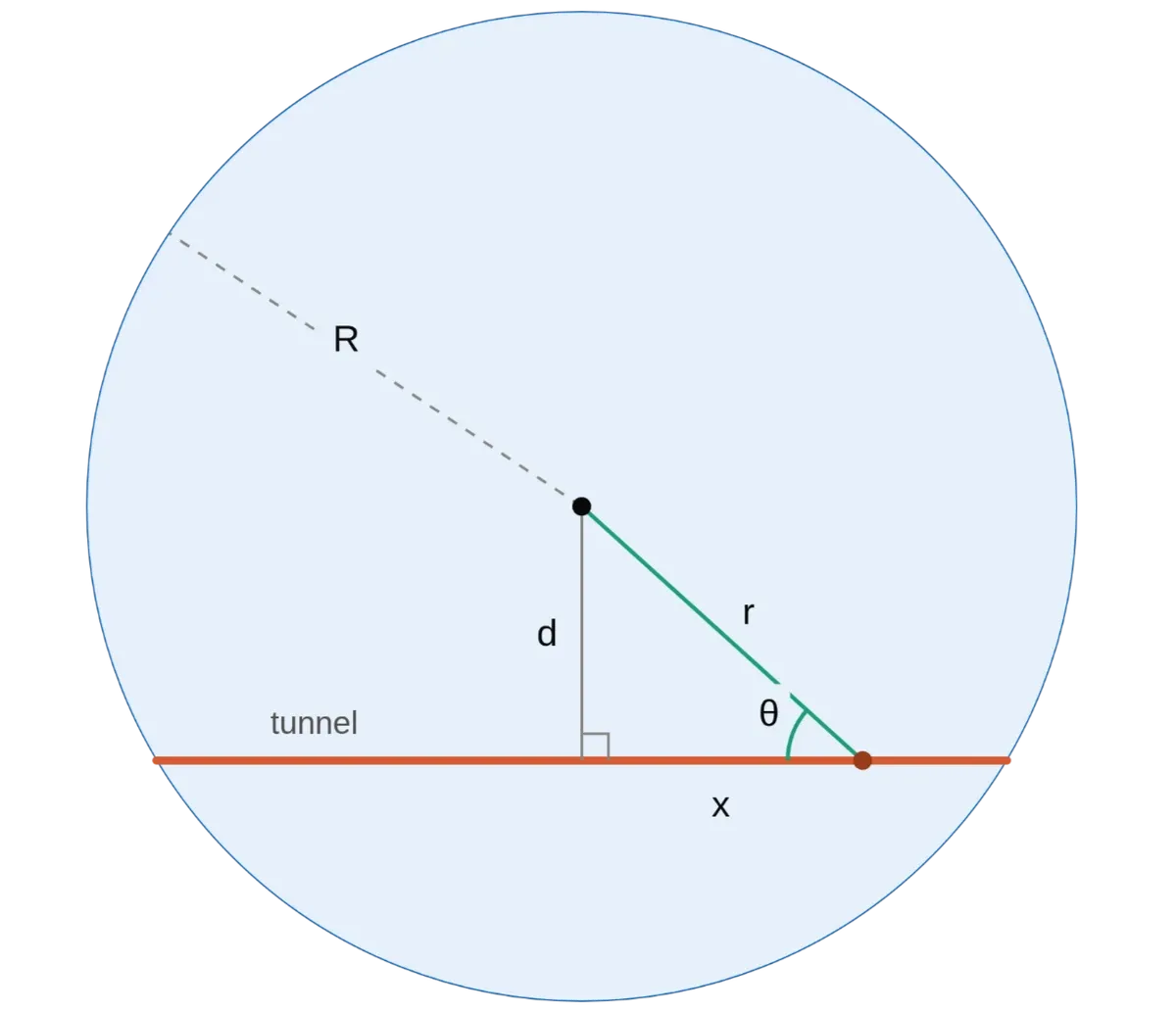
The walls absorb whatever acceleration pushes sideways, and only the along-tunnel component moves you.
The key is realizing that every straight tunnel obeys the identical equation:
Which is a simple harmonic motion for which we know that the oscillation period is constant for all amplitudes (i.e. for all tunnels). Released from one end, you’ll get to the other end at exactly half a period:
This fixes the constant dimensional analysis left open, , and, putting in (or equivalently km and )6, it gives our final answer:c
This is Paul Cooper’s result, published in 1966 under a title that gives the game away: Through the Earth in Forty Minutes.1 Every tunnel ties at the same 42 minute journey.
Second proof: just do the math, no oscillators required
Recognising simple harmonic motion and quoting its period is elegant, but it can be a bit unsatisfying if you’re anything like me. Let us do it the long way and just integrate the trip. The travel time is the accumulated :
So we need to calculate the velocity at each point of the tunnel to calculate the total time. We can get the velocity from our tunnel acceleration . Integrating it in time is not an option, because is precisely what we’re trying to find out, but we can integrate it in space. By the work-energy theorem, the work done by this acceleration corresponds to the change in kinetic energy.
Work-energy theorem: a quick reminder
The theorem says that the work done by a force is the same as the change in kinetic energy:
I always like to remind myself this is no mystery and it comes simply from the chain rule:
Which brings:
Given the initial speed is zero for the initial position in the tunnel , then:
We can now compute
The tunnel length cancels top against bottom perfectly. Physically, a longer tunnel hands you more ground to cover, but it also drops you faster, in precisely the proportion needed to break even. All in all, same 42 minutes.
What is not the same is how the trip feels. Top speed, reached at the midpoint , is
where is the initial position in the tunnel. Through the centre that is ~28,000 km/h, while down the ~900 km chord from London to Berlin (or Washington DC to Chicago) it is only ~2000 km/h. Yet same 42 minutes.
Interactive Demo 💡
The 42 minutes does not belong to the planet
Following up on our previous conclusion that fall time does not depend on radius, our 42 minute journey is not only true for all tunnels on Earth, it is true for a marble of Earth-density rock or a planet with twice the radius. Nothing changes. Increasing the distance is compensated by crossing faster.
If we take a moment to take our assumptions back, taking into account the non-uniform density of Earth that we get from seismic data, the pole-to-pole trip takes 38 minutes rather than 42. The equal-time property for all tunnels dies with it, with times ranging between 42 minutes for short hops and 38 minutes for the long ones.2 Also interestingly, reality is that gravity is not always decreasing as our linear formula suggests - given the increasing density with depth, gravity increases as you go down and peaks 9% above surface gravity near the boundary of Earth’s outer core.3
All in all, 42 is not a fact about Earth. It is a fact about any spherical rock, planet, moon or pebble made of the same stuff as Earth’s average density.
A twist: jump off a skyscraper
Keep the tunnel running straight through the centre, but don’t step in at ground level: climb a skyscraper first, and then jump. What happens?
Given no friction, when you rise out the other side, you get shot up to the exact height of an identical tower on the other side of the tunnel, arriving at rest on its roof. Makes sense! Do you still take the same time? Think about the answer before you keep reading.
We did say travel time was the same for all tunnels and all planet sizes, with one crucial assumption: constant density . Between the skyscraper and the ground, you are going through air, not rock, so it’s as if you lower the effective density of the planet until you get to the floor. And with lower effective density, if you look at the formula , you take a bit longer. An alternative way of seeing it is that above the ground, the linear gravity acceleration no longer holds, and instead it is replaced by the usual inverse-square law that decreases with height instead of growing. Hence, while you are outside, the pull is slightly gentler than our derivation expects.
As an example, from the top of the Burj Khalifa5 - 828 m - that outdoor detour adds a mere seven millisecondse to your trip. Overall, still 42 minutes for all that matters.
The Verdict
Every straight tunnel through the Earth is a 42-minute trip, whether straight through the center or a short hop between your favourite two cities. In fact, the 42 minutes holds for any sphere with the same density as Earth, as we predicted purely by dimensional analysis. As you increase the length of the tunnel, you also increase the speed you cross it, and it always perfectly breaks even.
Whatever else 42 may be the answer to, it is at least the answer for every straight tunnel through every ball of rock in the universe with Earth’s density.
Notes
a M, L and T are the three base dimensions - mass, length and time. Writing just says that , in SI units, is measured in ; most physical quantity’s units typically reduce to some product of these three.
b We get this result by applying the usual formula for gravitational acceleration and replacing the mass of the planet , where is the volume of the planet.
c For reference, water is 1000 kg/m3, diamond is ~3,500 kg/m3, silver is ~10,000 kg/m3, gold is ~20,000 kg/m3, so Earth’s average density of ~5500 kg/m3 is somewhere in the middle - makes sense.
d These are great-circle (surface) distances between the city centres: about 932 km for London to Berlin and 955 km for Washington DC to Chicago. Over such short spans the straight chord through the Earth is only about 1 km shorter, so the tunnel and the surface trip are practically the same length here.
e This is our own numerical estimate rather than a published figure. Below the surface the motion is the simple harmonic one derived above; above it, in open air, gravity instead follows the inverse-square law . Falling from height you reach the tunnel mouth at speed m/s (for m), and numerically integrating that open-air stretch and joining it to the underground oscillation gives a one-way fall through the diameter about 7 ms longer than the plain 42-minute trip. Fill the tower with Earth-density rock so the linear law holds throughout, and the excess is exactly zero.
Sources
1 P. W. Cooper, Through the Earth in Forty Minutes, American Journal of Physics 34, 68 (1966).
2 A. R. Klotz, The Gravity Tunnel in a Non-Uniform Earth, American Journal of Physics 83, 231 (2015). https://arxiv.org/abs/1308.1342
3 A. M. Dziewonski and D. L. Anderson, Preliminary reference Earth model, Physics of the Earth and Planetary Interiors 25, 297 (1981).
4 E. Parker, A relativistic gravity train, arXiv:1704.04026 (2017) - shows the fall period depends only on density, not on the sphere’s size. https://arxiv.org/abs/1704.04026
5 Burj Khalifa architectural height 828 m, Council on Tall Buildings and Urban Habitat (CTBUH).
6 Earth bulk parameters (volumetric mean radius 6371 km, mean density 5514 kg/m3, surface gravity ≈9.8 m/s2), NASA NSSDCA Earth Fact Sheet. https://nssdc.gsfc.nasa.gov/planetary/factsheet/earthfact.html