Can you make a 3-way Venn diagram? Part 2
Quite impossible to make - or is it?
Part 1 ended on a cliffhanger - we can draw three circles that are honest about every size and every pairwise overlap, yet the patch in the very middle, the triple overlap, draws itself. We don’t get to pick it.
Take for instance 3 sets of 100 elements with 40 elements in common between each pair. With circles this is what we get:
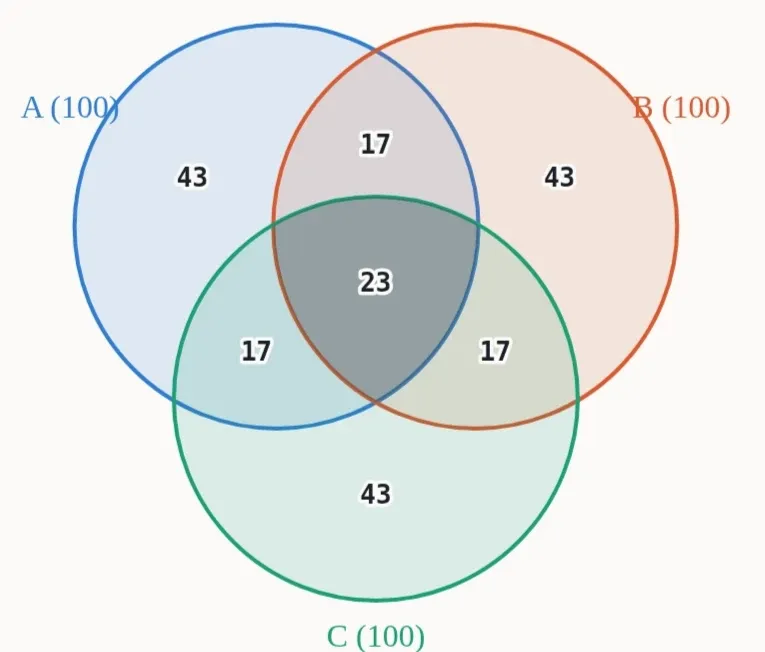
The middle is forced to 23 elements without choice. But the theoretical bounds allow for any value between 0 and 40 elements for the middle area. The middle could have little elements or many elements, as exemplified by these examples:
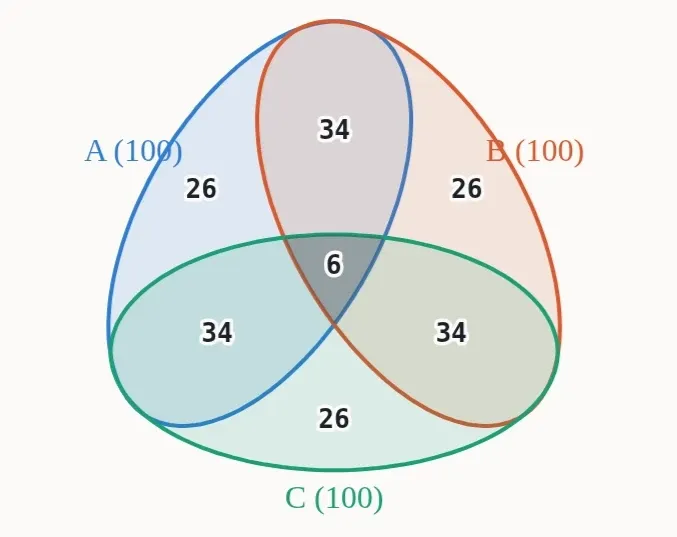
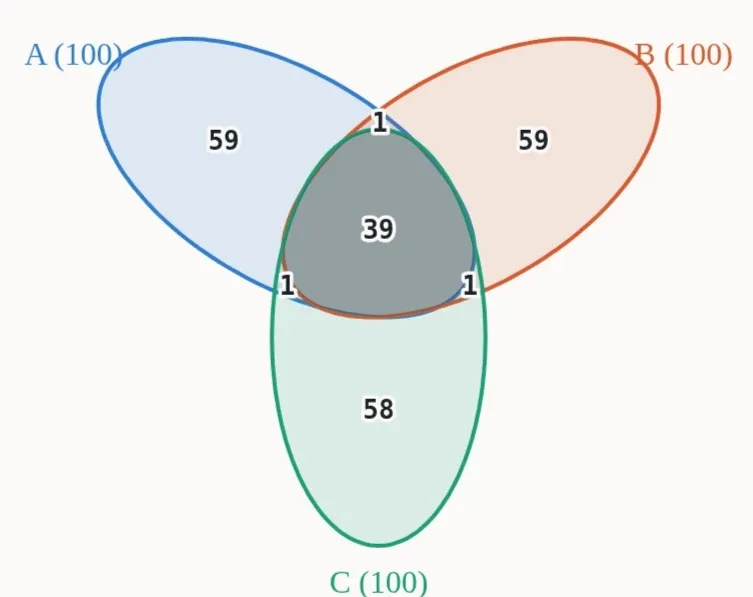
With circles we got close… three circles give 6 real knobs, while 3-way diagrams require 7 numbers: 3 sizes, 3 pairwise overlaps, and the triple. So we need one more knob.
The overkill solution: all ellipses
The blunt fix is to let each circle grow into an independent ellipse. Each ellipse has 5 knobs (instead of 3 for circles): its two center coordinates, its two axis lengths, and a tilt.1
Three ellipses, after removing our 3 invariant degrees of freedom (see Part 1 for details) bring 3x5-3 = 12 real knobs to chase our 7 targets. That solves the over-determination problem, sure - but now 5 knobs are left roaming free. Infinitely many different diagrams fit the very same data, and nothing pins down which one you get. It works, the way swatting a fly with a truck works. We wanted one more knob, not five. Can we do better?
The shortcut solution: one shared stretch
Let’s get stingy. Instead of giving every ellipse its own shape, we fix them in the following way:
- all three have the same stretch - one shared aspect ratio , where and are the axis lengths
- a fixed rule for the tilt (the way they point): its long axis aims at the shared center of the three.a
Starting with the circles’ 6 knobs, that single shared makes 7. We now have a square and exactly-determined system. Note that we have no a-priori reason to know this precise extra degree of freedom is enough to solve our problems. But of course, for the ellipses snap into circles, so this can either beat Part 1 or match it.
Does it actually work? Mostly yes. Almost all cases of real triple overlaps can be solved in this way, often with modest within , which are very close to circles. Extreme cases where the middle area is too small or too big still can’t be fully solved.
Numerical implementation
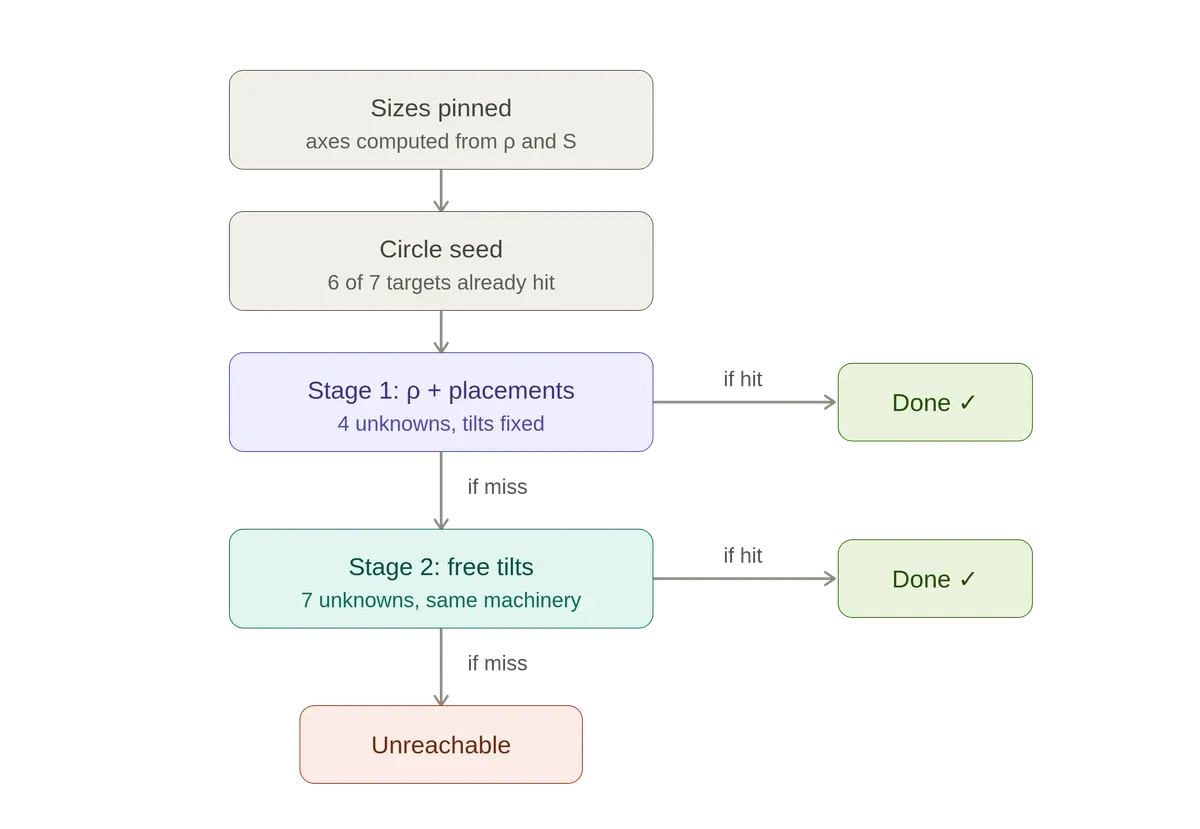
No tidy formula isolates , so the fit is numerical - same spirit as inverting the circle distance back in Part 1. We run a standard nonlinear least-squares routine2 with the initial conditions set to the circle solution (which already nails 6 of the 7 targets). In ellipses, with no closed formula for overlap, we measure areas by approximating the ellipses as fine polygons, clipping them against each other with the Sutherland-Hodgman method5 and computing the clipped polygon area via the shoelace formula.6 This keeps the areas changing smoothly as the shapes move, as required by a numerical solver.
To simplify the problem, the three ellipse areas never actually enter the numerical search. From the shared and the user input area for a given ellipse, and the two axes are calculated analytically:
so they are substituted at each step rather than solved for. This collapses 7 unknowns into 4 (, x-axis position of ellipse B, x and y position of ellipse C), giving a hand to the non-linear solver, which iterates until all four overlap area targets are hit.
Theoretical bounds on every area
Part 1 already boxed in the middle: the triple is trapped between and , the Fréchet bounds.3 The very same inequalities, rearranged, box in every pairwise overlap too - each lens has to hold at least whatever all three share, and it can’t outgrow the room left once the other lens in each group is seated:
So all seven areas pin each other down: give me any six and the seventh is trapped in an interval.
The middle ground: free the tilts
Between the two extremes sits one more option: keep the shared , but also let each ellipse’s tilt swing freely and independently. That’s 3 more degrees of freedom, totaling 10 knobs. When alone can’t hit the target, we can solve for this case only as a fallback.
The punchline: experimentally, there are actually very few cases where this extended solution earns its keep. In most cases, freeing the tilts gives no extra precision and misses the same cases as the only- shortcut case.
Numerical implementation
When the -only solver can’t meet the accuracy threshold, the fallback takes its solution as a seed, as well as the raw circle basic solution as a second seed, and, for both, it frees the three tilt angles alongside the existing 4 free parameters of the only- (7 free parameters instead of 4). If this second stage also misses, the target is outside what this family of shapes can reach.
Geometric limits
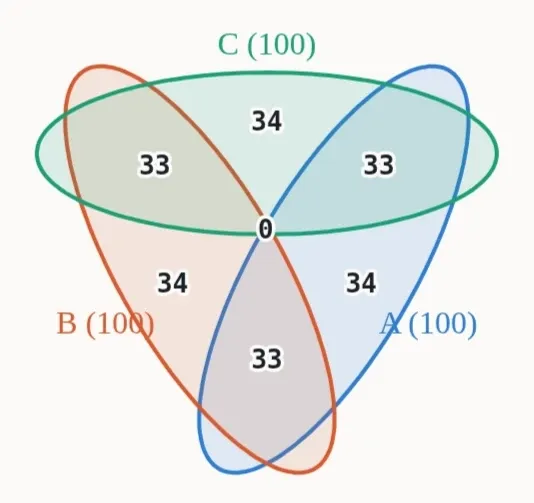
Given the theoretical bounds we predicted above, look at one clean extreme case worth thinking about: equal groups , equal pairwise overlaps , empty middle ABC=0. From the formulas, we can deduce that , i.e. no pair can share more than half of each group.
Real ellipses fall short of these theoretical bounds. Set theory says 50% overlap is the maximum, yet three ellipses top out around 33% overlap (see image below). That missing third is a geometric gap - the toll for shapes that meet in at most 4 points (Bézout’s theorem4) and so can never merge or bend an edge to erase the final sliver.
Where to go from here. That gap isn’t a dead end so much as an invitation: it’s the price of this family of shapes, not a hard law. Reach for richer shapes and more of the theoretically valid space opens up. For instance, you can definitely draw the 50% case by hand, if you allow yourself weirder shapes. A simpler case might be to allow for holes, as an annulus (an ellipse with an elliptical bite taken out), such that a region can wrap around another and buy back overlaps that a solid blob can’t. I won’t chase that here, but it’s worth knowing the 33% wall is a wall of our own making: spend more shape, and you can cover a lot more of what set theory says is allowed.
Interactive Demo 💡
The Verdict
So, can you make an honest 3-way Venn diagram?
- With circles, no - the middle draws itself
- With ellipses, yes - with one extra knob, a single shared stretch, you catch almost all reasonable 3-way Venn diagrams.
- Freeing ellipses further buys nothing.
The only targets still out of reach are the extreme ones, such as a zero middle wrapped in three big overlaps.
Three honest circles were one wish too many. Three honest ellipses, it turns out, need only a stretch. Go draw your own in the interactive demo above - circles, ellipses and all.
Notes
a We tried other tilt defaults - for instance, pointing each ellipse at the centroid of the three groups. Equivalent solutions were found in every case, showing that many valid choices exist and the tilt rule is not uniquely forced. We settled on the shared-center rule as the most geometrically natural.
Sources
1 Ellipse, Wikipedia (a conic in the plane is fixed by 5 parameters). https://en.wikipedia.org/wiki/Ellipse
2 Non-linear least squares, Wikipedia. https://en.wikipedia.org/wiki/Non-linear_least_squares
3 Fréchet inequalities, Wikipedia. https://en.wikipedia.org/wiki/Fr%C3%A9chet_inequalities
4 Bézout’s theorem, Wikipedia (two distinct conics meet in at most 4 points). https://en.wikipedia.org/wiki/B%C3%A9zout%27s_theorem
5 Sutherland-Hodgman algorithm, Wikipedia. https://en.wikipedia.org/wiki/Sutherland%E2%80%93Hodgman_algorithm
6 Shoelace formula, Wikipedia. https://en.wikipedia.org/wiki/Shoelace_formula