How many waffles do solar panels produce?
The sun makes more breakfast than the planet can eat
Quick: is 1.8 kWh a lot? Is 6.5 megajoules? What about 400W? Unless you do this for a living, those numbers mean nothing. Energy units were built for physics, not intuition.
Even Calories don’t fix it - “100 Calories” is just another abstract number. But the food behind the number is intuitive: everyone knows what eating a waffle feels like. And a waffle is just Joules in disguise:
So let’s measure the Sun and a solar panel in the only unit humans actually feel: breakfast. Let’s do the guesstimate.
Round 1: The Sky
First, our unit. A standard frozen waffle is about 90 kcal.1 In real energy:
How energetic is the sky? At bright solar noon, one square meter of ground soaks up about 1,000 W.2 Since a waffle is 0.38 MJ, a fresh one lands every:
One waffle every 6 minutes - almost as fast as the microwave. That is about 10 waffles an hour!
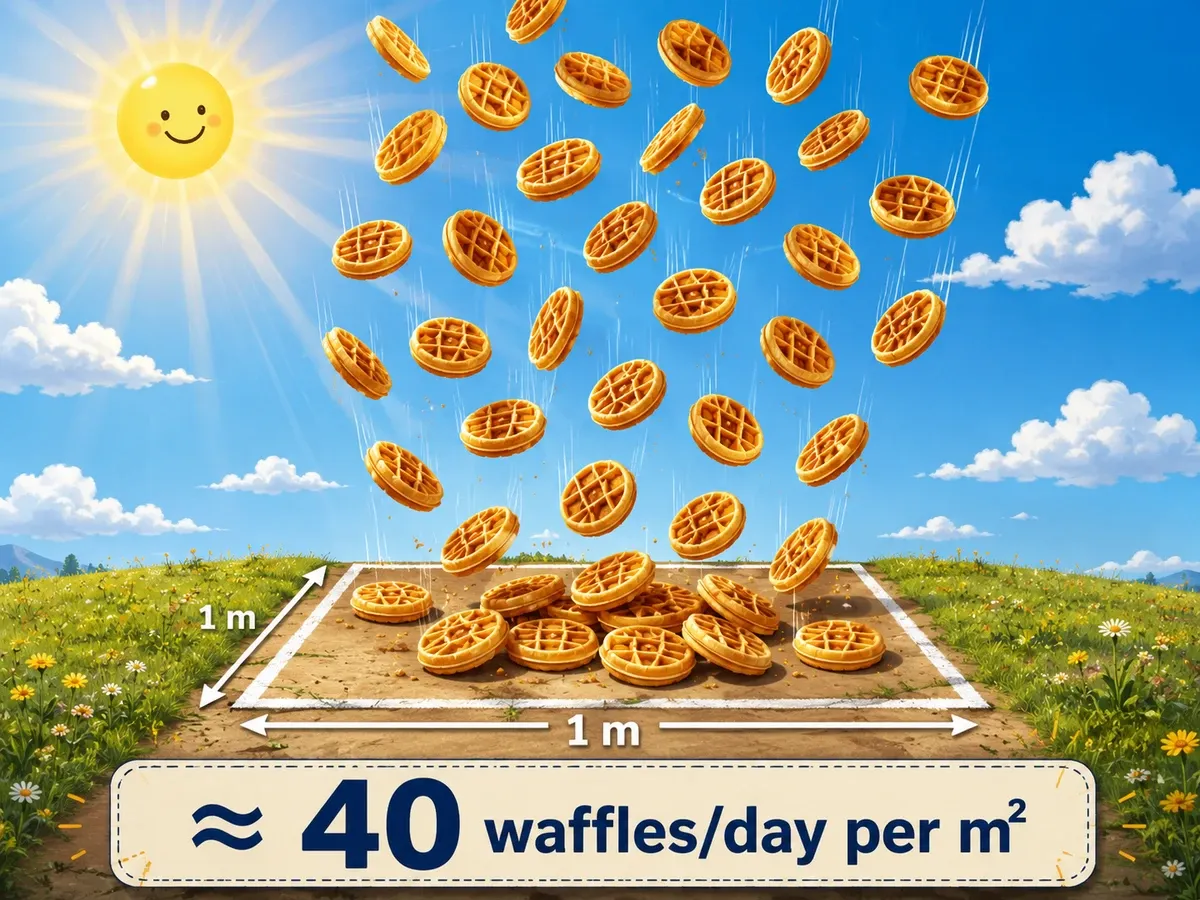
For a whole day, the sun only blazes near midday. Across a full day a square meter collects about 4.5 “peak sun hours” of energy3:
So call it ~40 waffles a day raining down on each square meter of the planet.
Sky at noon: 10 waffles/h/m2
Per day: ~40 waffles/m2
Round 2: The Solar Panel
How much of that rain can solar panels grab? A standard 2026 panel is rated 400 W across about 1.7 m2.4 5 6 At full sun that 1.7 m2 is hit by 1,700 W, so the panel converts:
of the sunlight landing on it into electricity.7 In waffles, while the sun shines it turns out:
Per day, knowing we have ~4.5 peak sun hours per day, the daily haul is:
Note that 17 waffles is about 1,550 Calories - close to three-quarters of a person’s daily recommended 2000 calories8, pulled from the sky for free in each solar panel. That’s quite insane!
Solar panel at noon: 3.8 waffles/h/panel
Per day: 17 waffles/panel ~ ¾ of a human daily intake
Watt?
Watt is the unit of power, which measures energy over time. One Watt is one joule per second (). A waffle is 380,000 J, so to make one waffle, the material metabolic energy in the waffle itself, we’d ~106 W for an hour - or ~6,300 W for a minute. For intuition:
| Thing | Power | Waffles |
|---|---|---|
| 💡 LED bulb9 | ~10 W | 0.1 / hour |
| 💡 Old incandescent bulb9 | 60 W | 0.6 / hour |
| 💻 Laptop charger10 | ~65 W | 0.6 / hour |
| ☀️ Our solar panel | 400 W | 3.8 / hour |
| ☕ Electric kettle11 | ~1,500 W | 0.24 / min |
| 🔥 Electric oven12 | ~2,400 W | 0.38 / min |
| ⚡ Tesla Supercharger13 | 250,000 W | ~40 / min |
So our panel is capped at a few bright bulbs, while a Supercharger inhales ~40 waffles a minute.
Filling a Pool
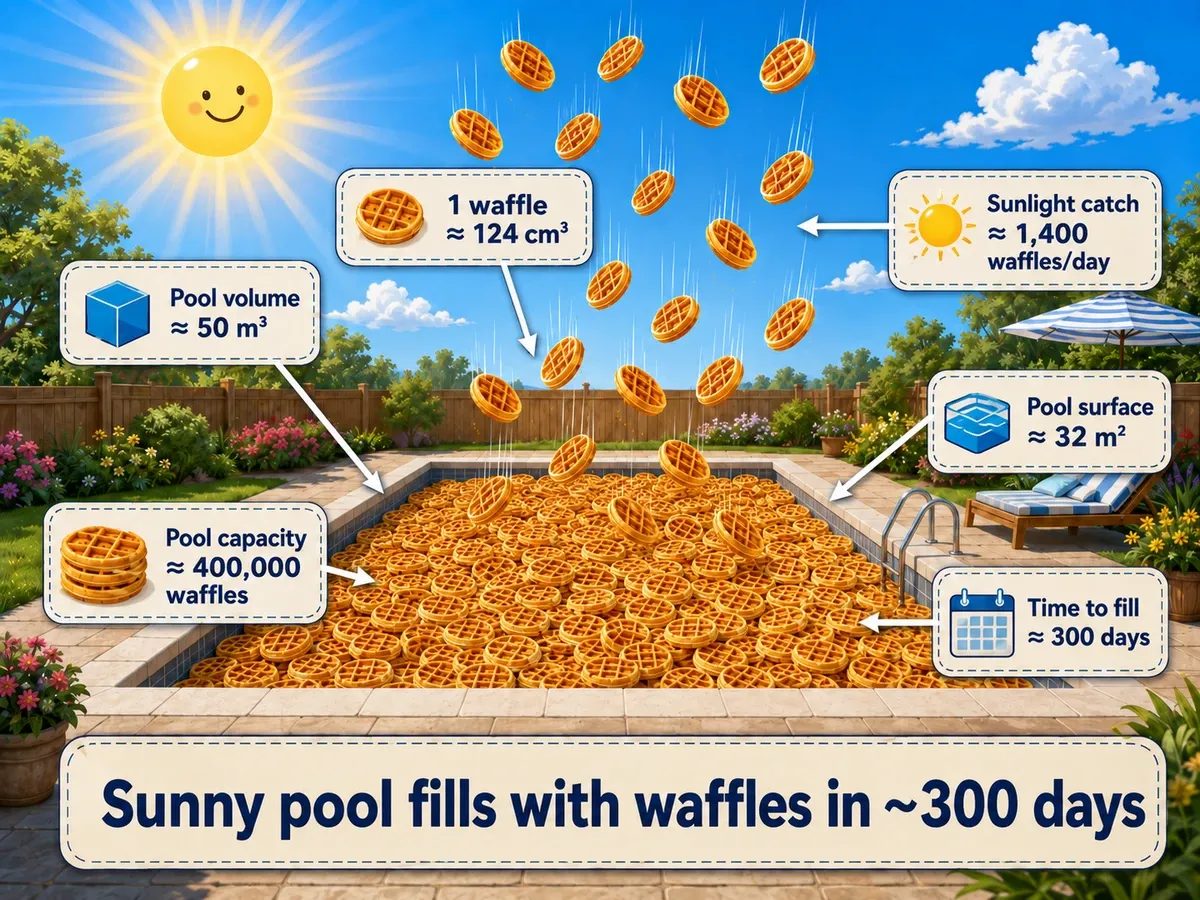
Could the sky itself fill a swimming pool with waffles? A backyard pool holds about 50 m3.14 A round waffle (~11 cm across, ~1.3 cm thick) is a small cylinder of , so the pool fits:
If a pool sits out in the open, catching the full ~40 waffles a day from the sun on each of a surface area ~32 m2 of surface14 - about 1,400 waffles a day. Filling it:
So a sunny pool gets enough energy per year to get completely overfull of waffles. A typical room is close to these 50 m3 (a bit less typically), so you can also imagine your bedroom getting filled with waffles in under a year.
Bonus: the Menu
The waffle earns its keep as a unit because the usual snacks sit right next to it: a banana (105 kcal), an apple (95 kcal) and an egg (72 kcal) are each about one waffle.15 16 So at full sun, the sun’s ~10 waffles an hour is also roughly ten bananas, ten apples, or ten eggs every hour.
The Big Mac is the outlier at 550 kcal - about 6 waffles each - so at noon the sun manages about one and a half Big Macs per hour.17
Interactive Calculator 💡
The Verdict
A solar panel pulls about 17 waffles of energy a day out of sunlight - roughly three-quarters of what a person eats, or about 4 waffles an hour while the sun is up. The sun is far more generous still: ~10 waffles an hour on every square meter at noon, almost all of which we never use.
You can’t eat the electricity, of course. But next time someone mentions a roof with 20 panels, you can translate: that is roughly 15 people’s worth of daily meals, falling from the sky.

Sources
1 Kellogg’s Eggo Homestyle Waffles (SmartLabel): 180 kcal per 2 waffles. https://smartlabel.kelloggs.com/Product/Index/00038000402401
2 Alternative Energy Tutorials: 1,000 W/m2 is the solar irradiance at the Earth’s surface at solar noon on a clear day - “one full sun” (Standard Test Conditions). https://www.alternative-energy-tutorials.com/photovoltaics/standard-test-conditions.html Irradiance peaks near solar noon (Penn State EME 812). https://courses.ems.psu.edu/eme812/node/644
3 Daily insolation ≈ 4.5 kWh/m2/day = 16.2 MJ (peak-sun-hours, as above5). Top-of-atmosphere solar constant is 1,361 W/m2 (NASA / Kopp & Lean 2011). https://earth.gsfc.nasa.gov/climate/projects/solar-irradiance/science
4 EnergySage, How Much Energy Does a Solar Panel Produce? (97% of 2025 quotes are 400-460 W). https://www.energysage.com/solar/solar-panel-output/
5 Nautilus Solar (400 W × 4.5 peak sun hours = 1.8 kWh/day). https://nautilussolar.com/blogs/how-much-energy-does-a-solar-panel-produce
6 A typical 400 W residential panel measures about 1.7 m × 1 m ≈ 1.7 m2 (≈67 × 39 in). https://solarpanelquestions.com/how-big-is-a-400w-solar-panel-key-facts-and-insights/
7 EnergySage: top residential panels ≈ 20-23% efficient. https://www.energysage.com/solar/solar-panel-output/
8 U.S. FDA, How to Understand and Use the Nutrition Facts Label: 2,000 calories a day is used as a general guide for nutrition advice. https://www.fda.gov/food/nutrition-facts-label/how-understand-and-use-nutrition-facts-label
9 LEDVANCE, LED Bulb Wattage Equivalent: 60 W incandescent, ~8-10 W LED equivalent. https://www.ledvance.com/en-us/professional-lighting/insights/blog/lighting-basics/what-is-the-equivalent-wattage-for-led-bulbs
10 Anker: average laptop charger 65 W (~45-100 W). https://www.anker.com/blogs/chargers/how-many-watts-does-a-laptop-charger-use
11 PowerInverters: standard kettle 1,200-1,500 W (UK 240 V up to ~3,000 W). https://powerinverters.com/electric-kettle-power-consumption
12 Energy Use Calculator: ovens 1,000-5,000 W, ~2,400 W average. https://energyusecalculator.com/electricity_oven.htm
13 Tesla V3 Supercharger: up to 250 kW. https://hysunpower.com/blogs/news/how-many-watts-does-a-tesla-charger-take
14 A typical European backyard pool is about 8 × 4 m - a ~32 m2 surface - and at a standard ~1.5 m depth that gives 8 × 4 × 1.5 ≈ 48 m3, rounded to ~50 m3 (about the same as a typical room). https://oasisbiosistema.com/en/blog/pool-sizes/ ; https://deependpools.co.uk/blogs/news/swimming-pool-size-whats-right-for-you
15 Banana: USDA via Food Network, medium banana 105 kcal. https://www.foodnetwork.com/how-to/packages/food-network-essentials/how-many-calories-in-a-banana Apple: USDA FoodData Central (FDC ID 1750340), medium apple (182 g) ≈ 95 kcal. https://caleye.fit/blog/calories-in-apple/
16 Large egg ≈ 72 kcal (USDA).
17 Big Mac sandwich = 550 kcal (CalorieKing; McDonald’s own current figure is 580 kcal). https://www.calorieking.com/us/en/foods/f/calories-in-sandwiches-burgers-big-mac-burger/atwb2iT2QqiH7k3guoeslg